

Introduction
Here's a question we hear often: "Should we move to Marketing Cloud Next now, or wait?" The honest answer? It depends. And that's not an evasive answer—it's because the decision genuinely depends on where your organization is right now.
In 2026, Marketing Cloud Next represents a real change in how companies approach digital marketing, data, and customer relationships. More than a natural evolution of Salesforce Marketing Cloud, this new generation introduces a model based on unified data, intelligent automation, and autonomous AI agents.
But the central question is not "what does the technology do." It is "when does it make sense to adopt it, with what objectives, and with what organizational maturity." That's where Marketing Cloud Next ceases to be just technology and becomes a strategic decision.
From Automated Marketing to Agentive Marketing
One of the most significant changes is the concept of agentive marketing. Instead of rigid flows and static campaigns, autonomous AI agents—Agentforce—are emerging, capable of executing, adjusting, and optimizing marketing actions based on near real-time data.
In practice, these agents can support campaign creation, adapt content, adjust segmentation, and optimize performance over time. Sounds good, right? It is. But there is one critical detail that we need to make clear right away.
Agents do not replace strategy or business knowledge
They work better — much better — in organizations that already have well-defined goals, consistent data models, clear governance rules, and alignment between marketing, sales, and service. Without these foundations, automation only accelerates inefficiencies. And no one wants to automate chaos.
Unified Data as a Foundation (not a promise)
Marketing Cloud Next is based on deep integration with Data Cloud, allowing you to create a unified view of the customer from multiple sources: CRM, digital channels, transactional platforms, and external systems.
This approach—often referred to as "Data 360"—unlocks more accurate segmentation, dynamic scoring, and real-time activation. So far, nothing new in the " " discourse. The problem is that unifying data is both an organizational and a technological challenge.
Data modeling, information quality, definition of ownership, synchronization rules — all of these are determining factors for success. And in the B2B context, where decisions are rarely individual and involve multiple contacts over long cycles, this becomes even more relevant.
Can the platform do this technically? Yes. But someone has to define what a "single customer" is in your organization. And that conversation is more difficult than it seems.
Automation and Journeys: Agility with Control
The evolution of automation tools—including Flow Builder and integration with CMS and Experience Cloud—allows you to create journeys more quickly and with greater flexibility than in the past.
This translates into less dependence on technical teams for simple changes, greater consistency across channels, and the ability to react more quickly to customer behavior. It's an operational change that frees up time and reduces friction.
Still, speed should not be confused with a lack of method. Effective journeys continue to require conscious design of touchpoints, clear definition of events and triggers, and alignment with business and service processes.
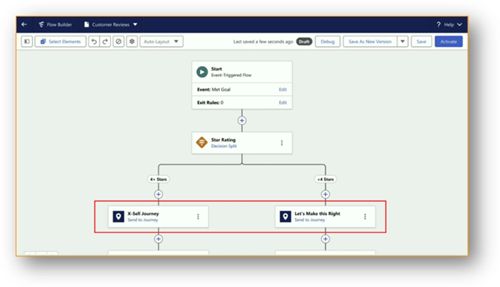
Technology accelerates, but design remains human.
Real-Time Personalization: High Potential, Maturity Required
Dynamic personalization supported by Agentforce allows you to adjust content, messages, and offers based on user behavior, context, and intent. When it works well, the experience is noticeably better.
This level of personalization is particularly powerful when data is up to date, business rules are clear, and there is a well-defined content strategy. Without these elements, there is a risk of creating inconsistent or irrelevant experiences—highly automated, but ineffective.
Continuous Analysis and Optimization with Actionable Data
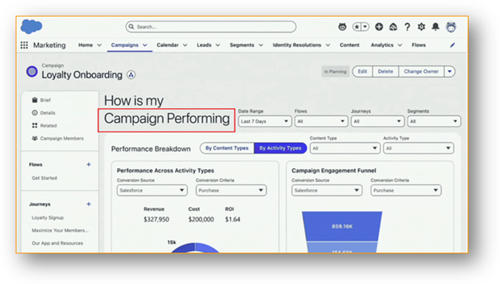
Integration with Tableau and advanced analytics capabilities allows you to monitor campaigns while they are running, adjusting investments, targeting, and messaging in real time.
This model favors decisions based on real data, continuous learning, and progressive performance improvement. Once again, technology provides insights—but it is strategic interpretation that generates value. Knowing that a campaign is converting at 12% is information. Understanding why and what to do next is intelligence.
Privacy, Consent, and Trust
In an increasingly demanding regulatory environment, Marketing Cloud Next incorporates robust consent and preference management mechanisms, aligned with regulations such as the GDPR.
More than a legal requirement, this dimension should be seen as an asset of trust: transparency in data use, user control, and more relevant and respectful communication. In a world saturated with messages, respect is differentiation.
What Realistically Changes for Organizations
Adopting Marketing Cloud Next is not an "immediate technological leap," but rather a phased journey. It typically goes through these stages:
- Data consolidation and quality
- Automation of critical journeys
- Integration with sales and service
- Gradual introduction of autonomous agents
The organizations that derive the most value are those that view this platform as part of an operational and cultural transformation, rather than just a marketing tool. It is a change in mindset, not just software.
Conclusion
Advanced Technology Requires Strategic Maturity
Marketing Cloud Next represents a new generation of marketing platforms—smarter, more integrated, and more adaptable in real time. That's a fact.
However, its true impact depends less on features and more on how it is implemented, governed, and aligned with the business. For companies, the challenge is not just adopting AI, automation, and unified data. It is deciding when, how, and for what purposes they do so.
It is in this balance between technology, strategy, and execution that the sustainable success of digital marketing in 2026 lies. And that is exactly where a consultative partner — not just a technical implementer — makes all the difference.
If you are assessing whether your organization is ready for this step, or whether it makes sense to take it now, it is worth talking. No pressure, no pitch—just an honest conversation about where you are and where it makes sense to go.
#Salesforce #MarketingCloudNext #WorldIT