

Introduction
In all business areas of an organization, including sales teams, productivity and information quality are critical to operations. It is common for companies to organize in-person events and participate in trade fairs. The collection and maintenance of information in a context that is often fast-paced and involves many contacts in a short period of time—and its subsequent follow-up—can be compromised when the information is not recorded reliably.
Although its use has decreased somewhat due to digital alternatives, physical business cards are still common, and efficiently capturing the information contained in a business card represents an opportunity to accelerate the sales process. There are clear gains in reducing manual work and ensuring that each new contact enters the CRM with greater accuracy and less friction.
This article outlines a solution for the effective capture of information from a business card into a CRM, through a mobile application capable of scanning business cards, extracting relevant information via OCR (Optical Character Recognition), organizing the data into categories, and automatically creating leads for follow-up in Salesforce.
Global Steps
The overall solution is based on a set of core building blocks that are typically used in sequence and address several key challenges:
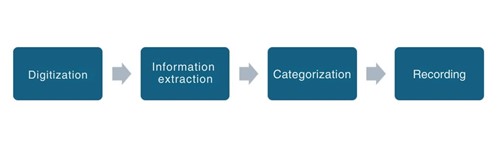
Business card scanning
A topic that for years could have been difficult to solve has become almost trivial thanks to the cameras in mobile devices, tablets, and desktops. Today, the image of the business card can be easily and quickly captured and made available for processing by the next block.
Information extraction
A wide range of libraries for extracting written (and non-written) information from images—OCR (Optical Character Recognition)—is now widely available across all operating systems. Using these libraries, we are ready for the next block: categorizing the extracted information.
Information categorization
Naturally, a heuristic approach does not accommodate the variety and different types of business cards. In an initial testing approach for the system blocks, we implemented information categorization based on rules and heuristics. For example, if the text contained the “@” symbol, it was classified as an email. If it consisted only of numbers, it was assumed to be a mobile phone number. This logic works in basic cases, but it naturally has many limitations, particularly because the set of rules that can be applied is minimal.
Fields such as a person’s name, company name, or address do not follow sufficiently consistent patterns to be reliably identified using fixed rules alone. In addition, OCR does not always return perfect results, especially when cards include symbols, complex layouts, or less conventional formatting.
Since user validation prior to submission is imperative, from the user’s perspective this resulted in many manual corrections, wasted time, and a non-fluid experience. From the standpoint of the intended objectives, this represented a breakdown in the core value of the solution: to automate and simplify.
The transition to an AI-based approach
To overcome these limitations, we sought to implement categorization using an Artificial Intelligence-based solution. After evaluating the available options—considering factors such as reliability, processing speed, cost, and availability across operating systems—we opted to use an OpenAI API. This shift enabled a key step forward: moving away from reliance on rigid patterns and towards interpreting the context of the extracted text.
In practice, this brings two significant advantages. On the one hand, it improves the robustness of the solution in the presence of OCR errors or imperfections. On the other, it enhances the ability to correctly identify ambiguous fields, even when the information is not presented in a predictable format.
This evolution is particularly important in real-world commercial scenarios, where there is a wide variety of business cards, brands, and visual styles. A solution that works only in ideal cases may seem sufficient in development, but it fails to scale when exposed to real-world conditions.
Recording and a data validation
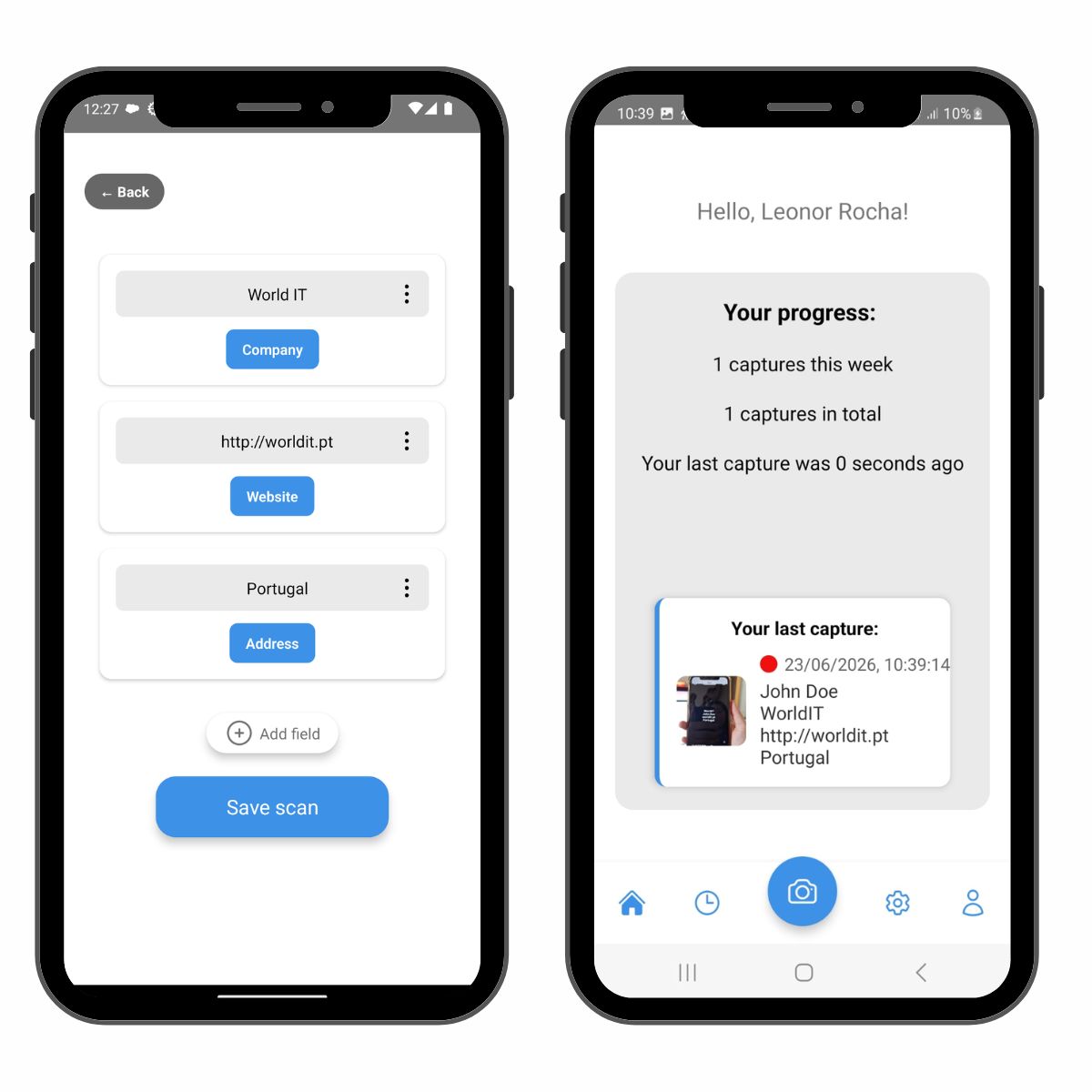
The implemented solution interacts directly with a CRM system—in our case, Salesforce. After AI-based categorization of the information, the user can validate whether the categorization appears correct and then submit the data to Salesforce.
At that point, the CRM can be queried via services to determine whether there is a high likelihood that the information already exists. If so, the user is presented with a warning message within the application, prompting them to confirm the action to take. This approach maintains a strong focus on data quality. It is also possible to submit data offline, ensuring that the application remains fully functional even in environments with limited connectivity.
Business value for sales and marketing teams
The main advantage of this type of solution is not solely the technology itself. It lies in the direct impact it has on sales productivity.
By automating the transition from a physical business card to a structured lead in Salesforce, the solution reduces repetitive tasks, minimizes the risk of human error, and accelerates sales follow-up. This is particularly valuable at events, trade fairs, in-person meetings, and networking contexts, where response speed can make the difference between winning or losing an opportunity.
In addition, by improving data quality from the very first interaction, the company benefits from cleaner information for segmentation, reporting, and marketing automation. Instead of spending time correcting data, teams can focus on developing opportunities.